Leeds needs trees!
Leeds City Council's Woodland Creation Team plans to plant just shy of six million trees by 2045. In this piece, Eliza looks at some of the planting schemes – and what they actually mean.

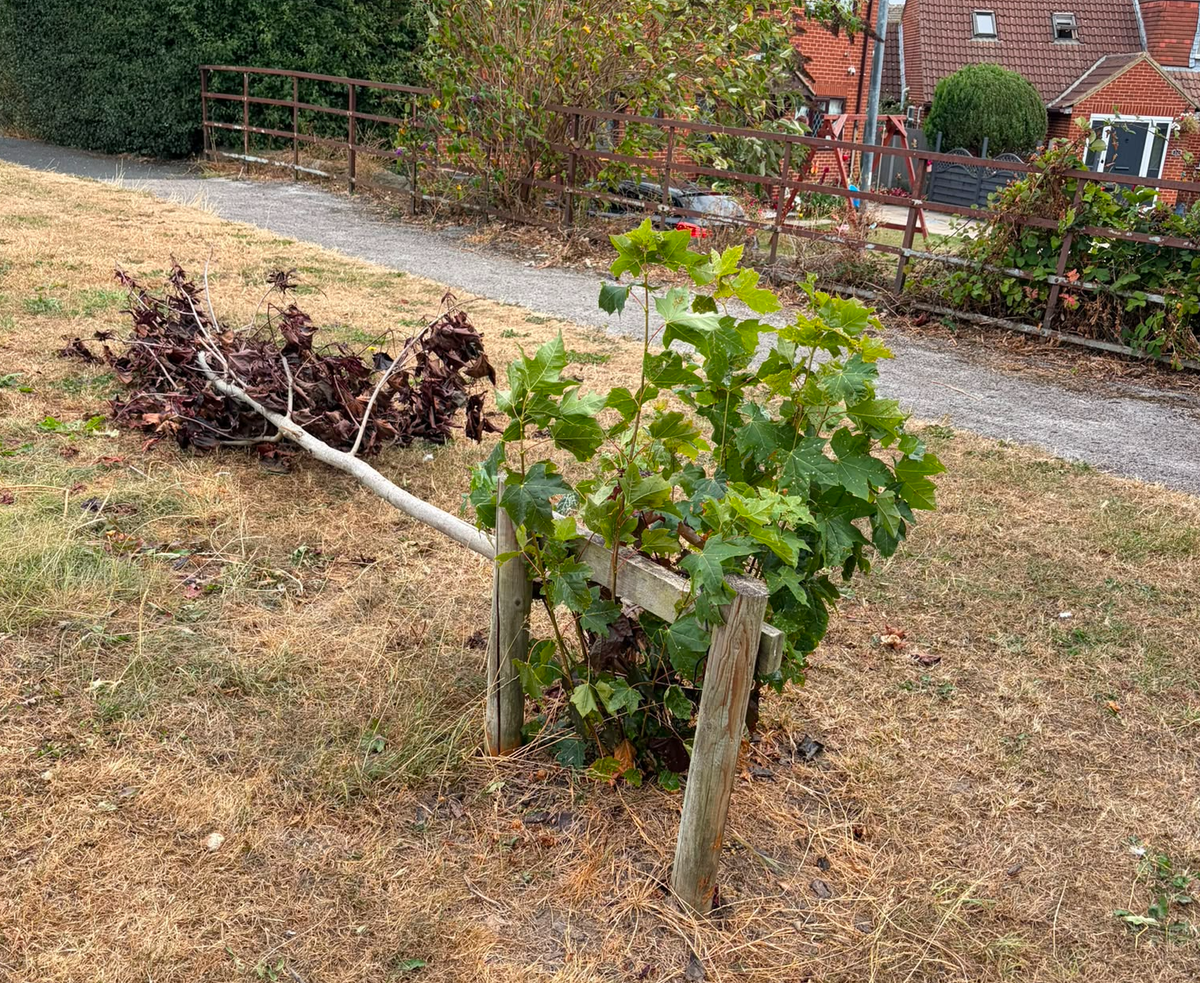
“Leeds needs trees! In 2019, Leeds declared a climate emergency. To combat this, we are planting millions of trees over 25 years.”
That is the bright, confident declaration at the top of the council’s Woodland Creation 2026 website. It reads like the opening line of a heroic civic saga: an odyssey about a city rising to meet the climate crisis with ambition, canopy and shade. “Look,” we can imagine it shrieking semi‑hysterically, “Leeds Council is going properly Green!”
But when you scroll down to the maps, the story shifts. The booming epic first becomes a quiet novella, then a pamphlet and then a post‑it on the fridge: “We’re planting a couple of trees this year. Don’t ask where.”
And yet where is the only question that really matters – because answered properly, it could become part of a decades‑long blueprint for real ecological corridors, real cooling shade and a city that finally plants with both an expansive sense of time and care about the climate emergency.
So, let’s look at where, then, shall we? outer west Leeds is a fine example of how these presumable “mighty warriors against climate collapse” turn out, in practice, to be a weary shuffle of light‑infantry saplings hobbling into the soft flank of enemy territory – an opening manoeuvre so disingenuous and timid it feels less like a charge and more like a retreat disguised as enthusiasm.
The entire planting programme for outer west Leeds – an area in total of around 3.8 hectares – amounts to four small sites in 2026. In Pudsey, Chatsworth Recreation Ground receives a compact block of whips tucked into a corner, a woodland fragment so modest it could be mistaken for the “nice, not too expensive” shrubbery demanded by Monty Python’s Knights Who Say "Ni!" – except even they would probably have asked for something bigger, and possibly with a second layer.
Clover Court and Swinnow Walk, both Pudsey residential greens, are earmarked for a handful of specimen trees placed directly in the central lawn, a design choice that seems to assume residents enjoy navigating around obstacles like contestants in a very slow, very polite assault course.
Wortley's Western Flatts Cliff Park, the only site with genuine ecological potential, gets 22 trees scattered across its open grassland, a pattern that whispers “ooh look, pretty!” more than it shouts “long‑term ecology strategy locked and loaded”.
If the inner west area fares better, though, it is only because Bramley Park appears to have absorbed all the ambition intended for the entire western half of the city. More than a thousand whips are planned across several shaped woodland compartments along the park’s northern edge.
It’s fragmented, but at least it is recognisably the “woodland creation” of the banner headline. Elsewhere, the pattern reverts to small gestures. Over in LS4, Burley Park receives 24 specimen trees across its mid‑field areas. Elida Gibbs Park, meanwhile, gets eight trees in a neat line along its northern boundary.
In Bramley, Stanmore Hill receives two trees squeezed into a triangular leftover green between houses. Also, in LS13, Norwood Crescent gets a small woodland block and five specimen trees in a constrained residential wedge.
Nearby street Rossefield Grove receives a triangular woodland block of 239 whips plus five trees tucked into the corner of a playing field while Summerfield Place gets two tiny woodland polygons totalling 114 whips inserted into the centre of a residential green.
Across the western half of Leeds then, the ecological pattern is strikingly consistent. The proposed planting is concentrated in leftover greens, residential edges and narrow movement corridors – places where trees will neither shade pavements nor cool the neighbourhoods that need it most.
Large, heat-stressed areas such as the A65 corridor through Guiseley, the dense terraces of Armley, and the exposed slopes of lower Wortley receive little or nothing, despite being some of the most vulnerable parts of west Leeds during summer heatwaves.
The result is a map of climate action that politely avoids the hard work: no cooling of heat islands, no strengthening of wildlife routes, no shade for the pavements that bake.
Instead, the planting appears to be planned where it is easiest rather than where it is most needed, producing a pattern of small, isolated pockets that do little to prepare west Leeds for the hotter, drier summers already arriving, let alone those of 25 years from now.
And this is where the gap between the slogan and the map becomes impossible to ignore. “Leeds needs trees!” is a fine rallying cry. It looks green on a banner. It sounds environmentally decisive in a committee room.
But when the practical expression of that ambition is a handful of whips tucked into corners and a scattering of specimen trees placed where they will neither shade pavements nor cool the neighbourhoods that actually overheat, the whole exercise starts to resemble a branding campaign rather than a climate strategy.
West Leeds is not short of land where real woodland creation could change the future. Continuous canopy along the A65 from Burley to Ilkley could cool one of the city’s most heat‑stressed, traffic-dense corridors.
A linked chain of woodland from Farnley’s green wedges to the valley floor could form a genuine climate‑resilience spine. The slopes above Calverley could anchor a cross‑plateau habitat route.
Pudsey’s western edge could connect directly into the Tong valley, creating one of the most significant ecological corridors in the region. These are not abstract ideas. They are real landscapes, already mapped, already understood, already waiting.
None of these is indicated in the plan.
Instead, the woodland‑creation programme offers a constellation of tiny polygons, decorative scatterings, isolated pockets of planting that will do little to cool streets, strengthen wildlife routes or buffer neighbourhoods against the hotter, drier summers already here.
It’s a missed opportunity so large it borders on the immoral – not because the council lacks good intentions, but because climate collapse, all Trumpian in its attitude, will not negotiate with smallness. Shade either exists or it doesn’t. Corridors either connect or they don’t. Heat either kills or it doesn’t.
Much of this pattern is likely explained not by ecological strategy but by administrative convenience: the 2026 planting sites sit almost entirely on small parcels of council‑owned turf where digging is cheap, permissions are automatic, utilities are unlikely to be disturbed and no negotiations with private landowners, rail operators or infrastructure bodies are required.
These are low‑risk, low‑maintenance spaces that allow quick delivery and high tree counts without the engineering, cross‑department coordination or long‑term commitments demanded by planting in the places that actually overheat.
In practice, the map reflects what is easiest to plant rather than what the landform needs, producing a constellation of polite, miniature gestures that will have little beneficial effect rather than the connected, topography‑led corridors that would meaningfully cool west Leeds.
If Leeds Council genuinely wants to transform a branding exercise into a climate strategy that will protect us all, it must abandon the convenience of municipal turf and take the fight directly to where the heat barbecues us extra-crispy.
That means retrofitting engineered tree pits into the sun‑scorched tarmacs of Armley’s terraces, lower Wortley and all along the A65 corridor, while forging bold, continuous ecological spines – stretching uninterrupted from Kirkstall’s riverside to Bramley’s heights, and weaving Farnley’s green wedges down to the valley floor – rather than scattering polite pockets of saplings like yesterday’s confetti across open grass.
It means breaking out of the administrative ease of council‑owned land to broker ambitious green‑finance partnerships across railway embankments, utility borders and private plots, while replacing the vanity metric of gross tree counts with functional targets that measure what actually matters: linear metres of shaded pavement, reductions in urban heat, and true canopy density in the city’s most vulnerable streets.
Residents in Leeds now have a chance to say so. The consultation is open. The maps are public. The gaps are visible. If Leeds is going to get the canopy it actually needs, we will all have to speak up in response – clearly and in numbers about its significant deficiencies, before this plan becomes the version of the future we are all expected to live in.
Because if Leeds Council were “properly green”, the planting would boldly match the scale of the crisis, not limp apologetically into leftover spaces, roughly equivalent to siting a new front door and pretending you’ve rebuilt the house.
Also in The Journal: we went on a journey to discover more about councillor Stephen Place, Bradford Council’s new leader:
For a while, Stephen Place was content with sharing his two cents on social media. He had no qualms about what he posted. This was who he was, what he thought and how he saw the world. Not that it mattered (basic civility notwithstanding). He wasn’t worth paying attention to. He didn’t have anything interesting to say. He was just another unremarkable and predictable voice on the online right drowned out by the feverish clamour of a “virtually lawless public square” overflowing with people clamouring to be heard and seen in an AI-powered “golden age of stupidity”.
Here's what we found out.