As Britain’s harvest shrinks, West Yorkshire starts to grow differently
The climate may be rewriting the rules, but West Yorkshire has always been good at rewriting them back.

If you want to understand the state of West Yorkshire in 2026, don’t bother with local MP statements about “resilience” or “robust supply chains”. Just walk into any supermarket in autumn and watch someone pick up a loaf with the same caution you’d use for an unexploded shell. The food system isn’t wobbling – it’s quietly keeling over, like a cow that’s been standing in the sun too long.
The UK’s 2026 harvest is a kind of slow‑motion ecological confession. According to early data from the Agriculture and Horticulture Development Board – the statutory levy board that monitors national crop performance – wheat yields are hovering around 6.8 tonnes per hectare.
In an ordinary year, UK wheat yields typically sit somewhere between 7.8 and 8.4 tonnes per hectare, depending on region and weather conditions, so 6.8 isn’t a collapse. But it is a clear slump. It’s the kind of drop that tells you the land is under stress, even if the supermarket shelves haven’t yet admitted it.
And when the Energy and Climate Intelligence Unit warns that extreme heat and drought may have “knocked as much as 2.5 million tonnes off cereals and oilseeds compared with earlier forecasts”, the picture sharpens.
That figure isn’t a precise tally – harvests are still being gathered, and estimates shift – but it’s large enough to matter. Large enough to suggest that what we’re seeing isn’t just a bad year or an unlucky season.
It’s the early edge of climate‑shocked agriculture: the kind of systemic weakening scientists have been flagging for two decades, highlighted in the National Emergency Briefing, while much of Britain sniffly nodded and carried on as if the weather would eventually calm down and behave itself like a good little child.
Meanwhile, vegetables are staging their own rebellion. Across Lincolnshire, East Anglia and Cornwall, for instance, irrigation reservoirs have shrivelled, soils have cracked and crops have ripened too fast, too small or not at all. Supermarkets that have heavily invested in supporting British-grown produce may regret that they can't buy rain.
Wholesale iceberg lettuce prices have jumped around 90%, tomatoes about 60%, and potatoes over 40%, while broccoli yields have halved in some areas, with growers literally combining two undersized heads to make one supermarket‑acceptable one – a kind of horticultural Frankenstein’s monster.
In West Yorkshire, this manifests as a peculiar supermarket melancholy. You stand in the veg aisle, contemplating a brassica that costs more than your bus fare, wondering whether civilisation is quietly collapsing behind the scenes while some other people waft breezily around insisting it’s just “supply chain issues”. It’s the kind of denial that would make a therapist scribble furious notes.
Yet even as the food system creaks, West Yorkshire has been quietly cultivating its own antidotes. Across Aireborough, the Incredible Edible beds have become small acts of defiance against the idea that food must always be scarce, expensive or shipped in from somewhere hotter.
A small but powerful team of dedicated volunteers have coaxed herbs, beans, kale and soft fruit out of Guiseley corners that once held nothing but compacted soil and old crisp packets, turning forgotten patches of land into places where anyone can pick something fresh without asking permission.
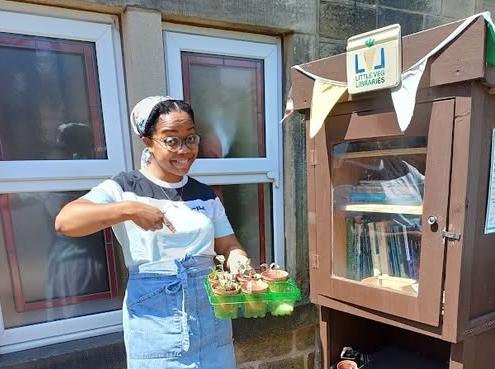
Feed Leeds has taken the same spirit and scattered it across the city in the form of Little Free Veg Libraries, small wooden boxes filled with surplus produce, seedlings and seeds topped up by neighbours who grow more than they need for anyone to help themselves to.
They’re modest structures, but they represent something quietly radical: a community deciding that access to food shouldn’t depend on supermarket prices, global supply chains or whether Spain has had another heatwave, but rather on the radicalism of local economies based in kindness.
In a year when the national harvest is faltering, these tiny, local growing schemes feel less like charming side projects and more like early prototypes of the future – fragments of a food system built on generosity rather than scarcity and on resilience rather than wishful thinking. They show what it looks like when care for each other becomes part of the everyday architecture of a place.
Zooming back out, the UK grows only about 56% of the vegetables we eat and a meagre 14% of our fruit. And these figures are falling. The rest comes from countries currently impersonating a climate‑disaster documentary.
Southern Europe has spent the summer baking under heatwaves that make our “hottest day on record” look like a warm bath. River levels have dropped. Export yields have shrunk. This situation isn’t going to alleviate.
The Mediterranean is no longer a sun‑kissed tourist idyll and backdrop to social media holiday posts. It’s a warning – a dire preview of the cascading ecological instability George Monbiot has been writing about for years, where food systems buckle long before anyone in Westminster notices.
But this is also West Yorkshire, so the collapse comes with a side order of absurdity. Chicken producers are squeezed by rising feed costs, fish prices wobble like a toddler on a balance bike, and frozen veg – that humble bag of peas – suddenly looks like the most sensible investment you can make.
It’s a distinctly British apocalypse: not dramatic, not cinematic, just quietly ridiculous. No zombies, no explosions, just a region of people squinting at the price of brassicas and muttering “Bloody hell”.
So what does a West Yorkshire household do? Not panic – panic is expensive, and supermarkets are poised to exploit it. Instead, you adapt in the way Yorkshire people always have: with mild irritation and an online trolley full of sensibly priced pulses.
Lentils, chickpeas, black beans – globally sourced, shelf‑stable and less exposed to British weather tantrums. They’re the dependable friend who shows up even when everyone else flakes. Grains like brown basmati, quinoa and buckwheat come from regions that haven’t spent the year impersonating a climate‑induced fever dream.
Frozen vegetables, flash‑frozen before drought impacts hit, won’t wilt in your fridge like a patient waiting twelve hours on a corridor trolley. And whole poultry, if you eat it, remains one of the few supermarket items whose price hasn’t yet completely lost its mind.
Local greengrocers, markets like Darley Street and Kirkgate and farm shops still offer decent value on storage veg – onions, cabbage, squash – and they’re less exposed to the cold‑chain chaos that supermarkets will face when imports falter. Wholesalers and world‑food aisles remain the best place to buy pulses and rice in bulk without paying the main‑aisle markup.
Timing matters too. Buying dry goods in bulk now in late summer makes sense, because retailers haven’t yet priced in the full harvest shortfall. Filling the freezer with frozen summer vegetables in early autumn will help you dodge the winter import squeeze. And buying roots and hardy winter veg weekly through the dark months keeps you connected to local supply rather than the increasingly unpredictable and dented global one.
None of this is a blip. It’s a preview. Our food system is being nudged – gently, persistently – into a new era of unpredictability. And West Yorkshire, with its mix of stubborn practicality, local growers and residents who can survive anything except a cancelled bus, is better placed than most to navigate it.
But muddling through won’t be enough. The age of cheap abundance is over and the age of deliberate resilience has begun. The future will belong to places and people that treat food not as a commodity but as a shared responsibility – to communities that understand that resilience isn’t a slogan but a daily practice.
And here, that practice is already visible: in the herb beds coaxed from compacted soil, in the veg libraries topped up before anyone asks, in the quiet graft of people who refuse to let the land give up.
This is the quiet but emergent revolution: ordinary neighbours turning forgotten corners into small, stubborn acts of abundance. The climate may be rewriting the rules, but Yorkshire has always been good at rewriting them back.
So yes, the weekly shop has become a regular philosophical exercise. But it’s also becoming something else: a reminder that the future of food won’t be secured by supermarket logistics or ministerial optimism. It will be secured by the people who plant, share, tend, and refuse to look away.
And perhaps that’s the real story of 2026 – not collapse, but the first outlines of a new kind of plenty, drawn by communities who understand that the only way to weather a changing world is to grow one together.
Also in The Journal: we went on a journey to discover more about councillor Stephen Place, Bradford Council’s new leader:
For a while, Stephen Place was content with sharing his two cents on social media. He had no qualms about what he posted. This was who he was, what he thought and how he saw the world. Not that it mattered (basic civility notwithstanding). He wasn’t worth paying attention to. He didn’t have anything interesting to say. He was just another unremarkable and predictable voice on the online right drowned out by the feverish clamour of a “virtually lawless public square” overflowing with people clamouring to be heard and seen in an AI-powered “golden age of stupidity”.
Here's what we found out.